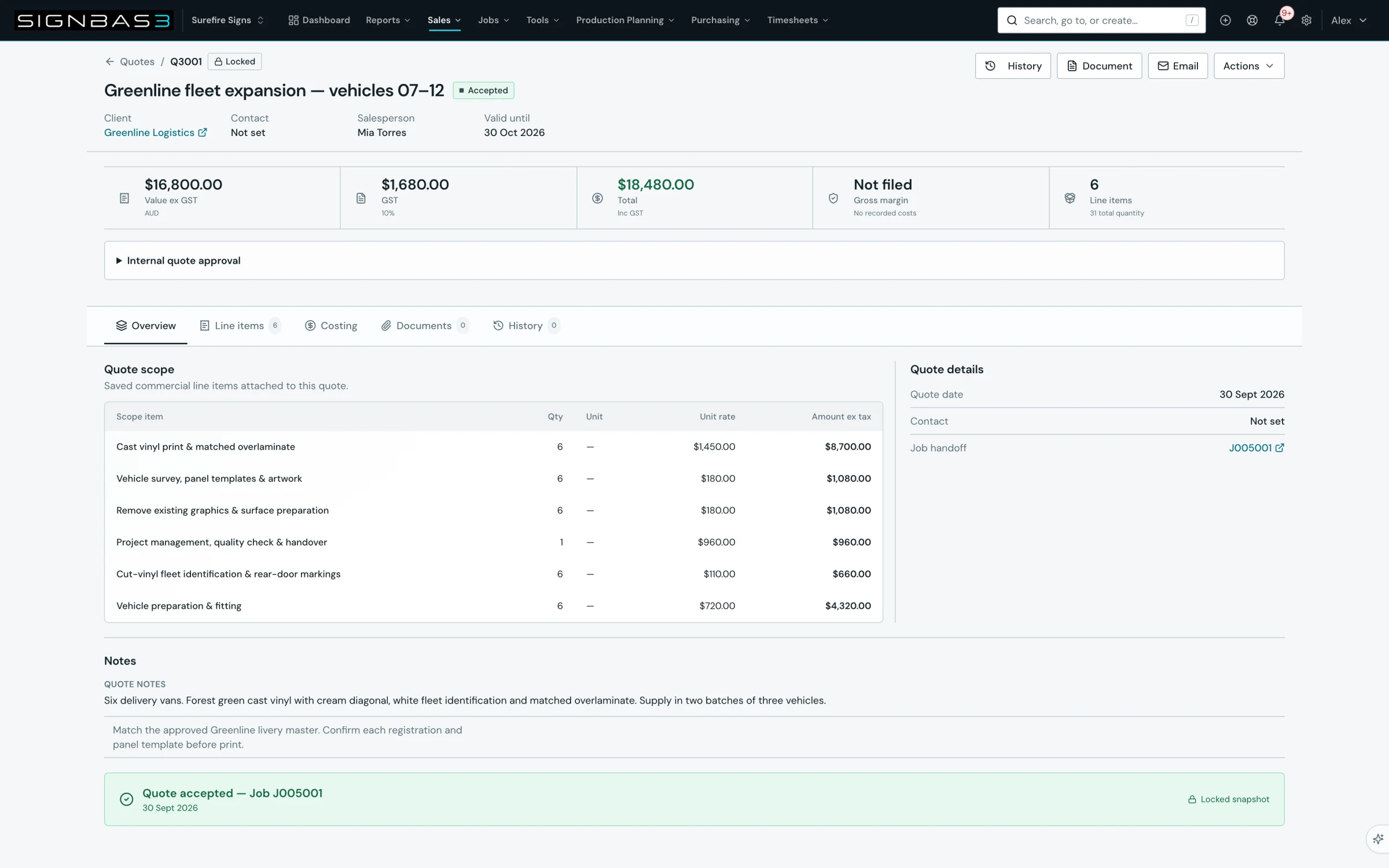
Your customer reviews the scope and price, then accepts online. The decision stays with the quote.
01Send the quote
One link to the priced scope, totals and terms.
02Accept online
The customer adds their name and optional notes.
03Start the job
Convert the accepted quote with its agreed scope.
✓Customer name · acceptance date · notes
01
Import or build the detail
Bring in editable quote lines, task hours, purchasing allowances and client context—or build the quote directly.
02
Online quote approval
Customers review the quote in their browser and accept with their name and optional notes.
03
Clean job handover
Production receives the version the customer actually accepted.
Illustration · how the workflow fits together
A practical workflow
What it looks like in use.
01 · Import or draft the scope
Start with the client and either upload a compatible pricing workbook or describe the work directly.
02 · Check the numbers
Review every imported or entered line, hour, allowance and margin assumption.
03 · Issue and revise
Keep every customer-facing version in the commercial trail.
04 · Get the customer’s go-ahead
Send the online quote, record acceptance and convert the agreed scope into a job.
Built for custom sign work
Price the work the shop will actually deliver.
A useful sign estimate records more than a total. Capture the client and site, quantities and dimensions, products and materials, labour, production stages, purchased inputs, finishing, delivery and installation requirements in a structure the next department can understand.
Use repeatable quote content for familiar work while keeping enough flexibility for banners, vehicle graphics, wide-format print, fabricated signs, LED work and site installation. The commercial record remains recognisable when the job reaches artwork, purchasing and production.
What sign estimating and quoting software should preserve
Estimate detail
Why it matters after acceptance
SignBas3 approach
Customer and site
Production and installation need the right contact, location and delivery context.
Client, contact and job context remain part of the commercial record.
Products and specifications
The workshop needs to know exactly what was sold, including quantity, size and production intent.
Structured quote items carry the agreed description and scope forward.
Materials and outside supply
Required stock and supplier work affect purchasing, readiness and actual cost.
Estimate detail can inform job requirements and purchasing allowances.
Labour and production work
Estimated effort provides a commercial baseline for planning and job costing.
Labour and production structure remain available when accepted work becomes a job.
Artwork and revisions
The team must distinguish the current commercial scope from an earlier option.
Quote revisions and acceptance history identify what the customer agreed to.
Delivery and installation
Freight, access, site work and field labour can change both price and delivery planning.
Installation requirements stay visible as the job moves into scheduling and mobile work.
Estimate to production
Acceptance should remove a handoff, not create one.
When a customer accepts the quote, SignBas3 keeps the agreed scope attached as the work moves into the job. Artwork can start from the sold specification, production tasks can reflect the promised work, purchasing can see required inputs and management has an estimate to compare with actual labour, materials and supplier costs.
Custom sign work changes. Quantities move, materials are substituted, artwork develops and installation requirements become clearer. Retain each quote revision, send the current version and preserve customer acceptance so sales and production can identify the live scope without reconstructing it from email.
SignBas3 can also bring an existing quote-calculator workbook into a guided import workflow, helping a business preserve useful pricing structure while moving away from disconnected spreadsheets.
Test sign estimating software with a representative quote
Create a client and site with a realistic delivery or installation requirement.
Price several sign items with different quantities, dimensions, materials and production work.
Add purchased input and labour so the commercial baseline reflects the job.
Revise the scope and prove the team can identify the current version.
Record customer acceptance and move the agreed work into a job.
Check that artwork, production, purchasing and job costing can use the estimate without re-entry.
The measure of a good estimateThe customer can understand what they are buying, production can understand what it must deliver, and management can compare the final result with the commercial decision that started the job.
Repeatable pricing without lowest-common-denominator quotes
Standardise the inputs and keep flexibility for custom work.
Consistency does not mean every sign uses the same formula. It means estimators work from a shared commercial structure: customer and site, product, quantity, dimensions, material, production method, labour, outside supply, finishing, delivery, installation, overhead and margin.
Repeatable products and quote content accelerate familiar work. Custom line items and job-specific requirements preserve the reality of a fabricated sign, vehicle wrap, illuminated cabinet, multi-site wayfinding package or unusual installation. The team can quote quickly without hiding the work that makes the price credible.
Turn the estimate into an operating baseline
The accepted estimate should remain useful after the sale. SignBas3 carries products, specifications, labour allowances, material expectations, supplier inputs and delivery requirements into the job so artwork, purchasing, scheduling and production begin from what the customer bought.
That baseline also gives management something meaningful to compare with actuals. When labour, material, supplier or installation cost moves, the business can identify the variance against the commercial assumption rather than merely observing that the final margin was lower.
Price different sign work with the same commercial discipline
Use the cost drivers that fit the product.
A banner may be driven by finished area, media, print, finishing and freight. Vehicle graphics add design, print, laminate, preparation and installation effort. Fabricated or illuminated signage may include sheet materials, routed components, welding, paint, LEDs, power supplies, engineering, access equipment and site work.
SignBas3 keeps these details structured inside the quote while preserving a clear customer-facing scope. The customer sees what is being offered; the workshop receives the production intent; management retains the assumptions behind price and margin.
What a strong sign quote should make explicit
Commercial question
Why it belongs in the quote
What happens after acceptance
What exactly is being supplied?
Products, quantities, dimensions, materials, finishes and inclusions define the customer promise.
The job and artwork workflow begin from the accepted specification.
What work will the shop perform?
Design, prepress, print, fabrication, finishing, quality and installation effort shape price and capacity.
Production tasks and estimated effort create the plan and later labour comparison.
What must be purchased?
Materials, subcontracting, freight and equipment affect lead time, readiness and margin.
Purchasing can raise job-linked orders and return actual supplier cost.
What must happen on site?
Access, travel, crew, equipment, delivery and installation conditions can materially change scope.
Site and field requirements continue into scheduling and mobile work.
Which version did the customer accept?
Revisions may change products, quantities, options, price and delivery commitment.
The accepted revision remains the operational and costing baseline.
Close the estimating feedback loop
Let completed jobs improve the next price.
Actual labour, material use, supplier spend, production evidence and installation effort reveal where the estimate was strong and where its assumptions moved. SignBas3 keeps those actuals around the job so the lesson can return to pricing while the work is still understandable.
A variance may point to an outdated material allowance, underestimated design time, missing freight, site access or a scope change that should have been priced. The evidence tells the estimator which commercial input needs attention instead of applying an unexplained increase across every quote.
Can SignBas3 quote both repeat and custom sign work?
Yes. Repeatable products and quote content support familiar work, while structured custom items preserve the dimensions, materials, labour, production, purchasing and installation requirements of unique jobs.
Can an accepted quote become a production job?
Yes. The accepted commercial scope carries into the job so artwork, purchasing, scheduling and production can continue without re-entering the sold work.
Can SignBas3 preserve quote revisions and customer acceptance?
Yes. Each revision remains distinct and the accepted version identifies the exact products, scope, price and delivery commitment that became the operational baseline.
Can completed jobs improve future estimating?
Yes. Actual labour, purchasing, materials, production and installation remain connected for estimated-versus-actual review and stronger future pricing.